Software Engineer Resume Example (ATS-Friendly) + Keywords & Breakdown
You’re not getting “ghosted.” You’re getting filtered. Most Software Engineer resumes don’t fail because the experience is weak — they fail because the document doesn’t parse cleanly and the content doesn’t match the job description’s keyword model.
Reality check: 95%+ of mid-to-large employers use ATS software before a recruiter ever sees you. If your resume is visually “nice” but structurally hostile (columns, icons, text boxes), you can lose match score before your actual work is even evaluated. The goal: a Software Engineer resume that reads like a human wrote it — but behaves like a database record.
This is a Software Engineer resume example + breakdown: how to format for ATS, how to write bullets that score, and a copy/paste-safe sample you can customize fast.
Trend / Impact / Action (ATS Reality for Software Engineers)
Trend: SWE resumes get graded by parsers + keyword systems first
- ATS platforms (commonly Greenhouse, Lever, Workday, iCIMS) ingest your resume, extract fields, and run keyword/ontology matching.
- For engineering roles, automated scoring heavily weights hard skills + tooling + job-title alignment + recency.
- High inbound volume means borderline resumes don’t get “a chance.” They get auto-deprioritized.
What this means for you
If your resume can’t be reliably extracted into:- Title / level (Software Engineer II vs Senior vs Staff)
- Skills (React, Node, AWS, Kubernetes, SQL, etc.)
- Experience (company, dates, location, outcome-focused bullets)
Action: Build an ATS-native Software Engineer resume
Patience isn’t optional. Precision isn’t either.
Software Engineer Resume Example: what an ATS-friendly version looks like
You can be a strong engineer and still get filtered because of totally fixable resume issues:
- Two-column templates (experience gets scrambled)
- Icons for GitHub/LinkedIn (links don’t get captured as plain text)
- Skill charts / “clouds” (non-parsable)
- Task-only bullets (weak evidence + weak keyword coverage)
Before vs After (how to write SWE bullets that actually score)
Before (common dev resume bullet)
- “Worked on microservices and improved performance.”
After (ATS-native, indexable bullet)
- Reduced API p95 latency 35% by tuning PostgreSQL query plans and adding Redis caching in a Go service on AWS (ECS/RDS).
Before (skills section only)
- “React, Node, AWS, Docker, Kubernetes”
After (skills + proof in experience)
- “Built React analytics UI; shipped a Node.js BFF; deployed on AWS with Docker/Kubernetes; added OpenTelemetry tracing; improved error rate 1.8% → 0.6%.”
5 Quick Fixes (highest ROI for an ATS-friendly Software Engineer resume)
- No columns, tables, text boxes, icons, charts, skill bars.
- Exactly: Professional Summary, Technical Skills, Professional Experience, Education, Certifications (optional).
- Use what employers index on: Software Engineer, Software Engineer II, Senior Software Engineer, Staff Software Engineer.
- If your internal title is weird, map it: “Software Engineer (Backend) — internal title: Product Engineer”.
- ATS weights bullets more than a standalone skills list.
- Every major skill should appear at least once in experience context.
- Pick 2–4 metrics per role: latency, throughput, error rate, uptime, cost, deploy frequency, lead time, SLO/SLA.
Gold Standard: Software Engineer Resume Sample (ATS-Friendly)
> Copy/paste safe. Single column. ATS-readable headers. Keyword coverage in context.
ALEX JOHNSON San Francisco, CA | 555-012-3456 | alex.johnson@email.com LinkedIn: linkedin.com/in/alexjohnson-dev | GitHub: github.com/alexj-codes
PROFESSIONAL SUMMARY
Software Engineer (Backend/Platform) with 6+ years building distributed systems and cloud-native services. Strong record improving latency, reliability, and cost across microservice architectures. Core stack: Go/Python, Node.js, AWS, Kubernetes, PostgreSQL, Redis, Kafka, Terraform, CI/CD.TECHNICAL SKILLS
Languages: Go, Python, TypeScript, Java, SQL Frontend: React (as needed), Next.js Backend: Node.js, FastAPI, gRPC, REST, GraphQL Cloud/DevOps: AWS (ECS, EKS, Lambda, S3, RDS, CloudWatch), Docker, Kubernetes, Terraform, GitHub Actions, Jenkins Data/Storage: PostgreSQL, Redis, DynamoDB, MongoDB, Kafka Quality/Obs: TDD, Jest, PyTest, OpenTelemetry, Prometheus, Grafana Practices: System design, microservices, event-driven architecture, SRE basics (SLOs/SLIs)PROFESSIONAL EXPERIENCE
CORE TECH SOLUTIONS | Senior Software Engineer San Francisco, CA | January 2023 – Present
- Reduced API p95 latency 35% by tuning PostgreSQL query plans and implementing Redis read-through caching for high-traffic endpoints in a Go service.
- Built an event-driven workflow using Kafka and AWS (ECS/RDS/S3), processing 500k+ events/day with 99.99% service uptime.
- Implemented OpenTelemetry tracing and standardized dashboards in Grafana, cutting MTTR 42% by improving log/trace correlation.
- Shipped infrastructure as code with Terraform and automated deployments via GitHub Actions, reducing deploy lead time 45 min → 12 min and increasing deploy frequency to 50+ deploys/day.
- Led containerization of legacy services with Docker and Kubernetes (EKS); decreased compute spend ~18% through right-sizing and autoscaling.
- Developed Python services for real-time ingestion and enrichment, sustaining 500k+ events/sec with sub-second processing using Kafka and PostgreSQL.
- Delivered a customer analytics dashboard in React; improved Core Web Vitals (LCP) 50% by code-splitting and query optimization.
- Built a Node.js BFF layer to consolidate upstream APIs, reducing frontend round trips 30% and improving p95 response time ~22%.
- Increased test coverage 60% → 92% with PyTest/Jest and CI gates; reduced production regressions ~30%.
- Built REST APIs in Node.js (Express) supporting a consumer app with 100k+ downloads; improved error handling and reduced 5xx rate ~25%.
- Supported migration from on-prem to AWS (EC2/S3/RDS) and introduced basic CloudWatch monitoring and alarms.
EDUCATION
B.S. Computer Science, University of Texas at AustinCERTIFICATIONS
AWS Certified Solutions Architect – Associate | CKAD (optional)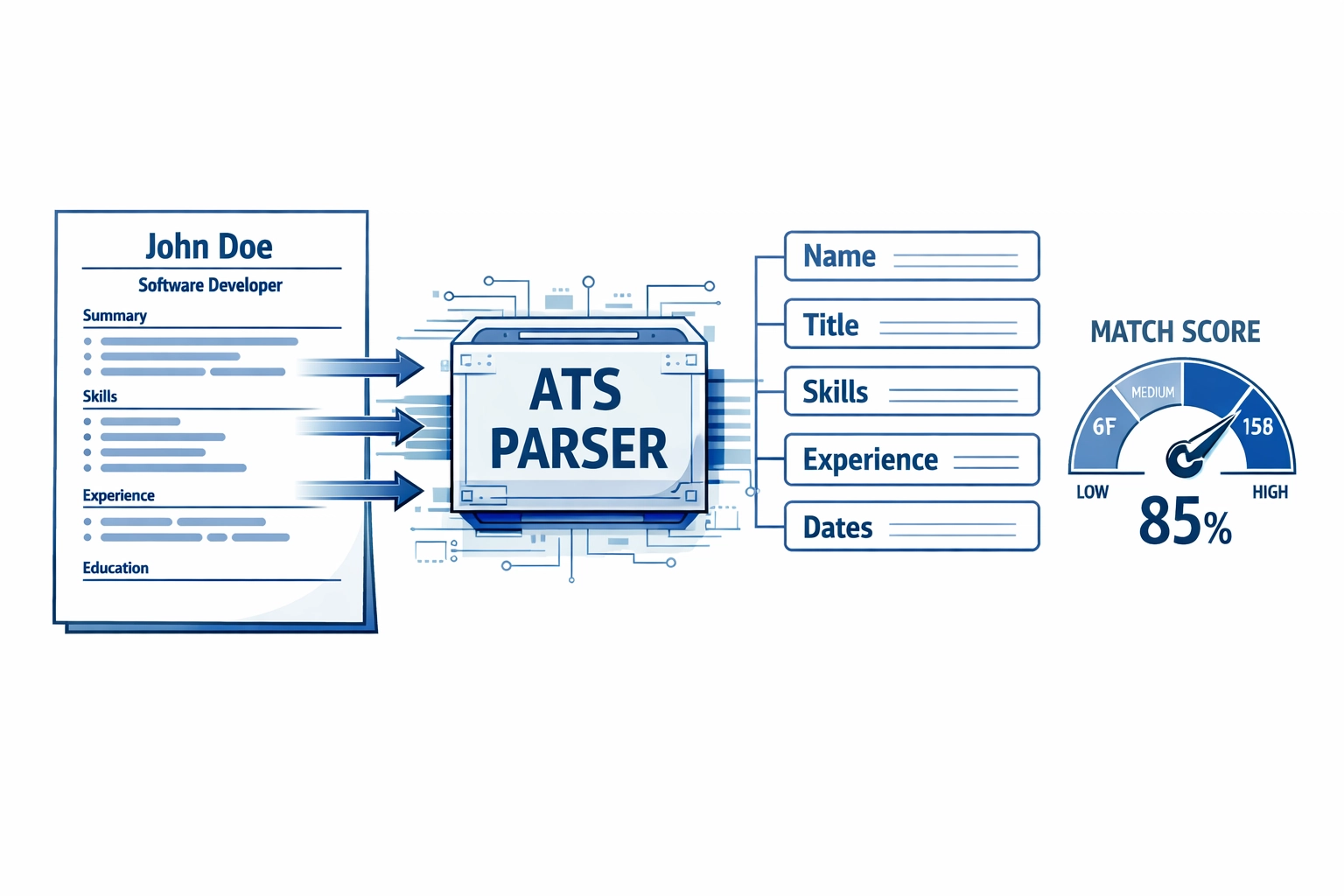
Breakdown: why this Software Engineer resume example works (ATS + recruiter scoring)
1) It’s optimized for ATS parsing
- Single column, no graphics, no embedded icons.
- Machine-readable headers and consistent date formatting.
- Clear separation of skills vs experience so the ATS can map both.
2) It nails the scoring surface area
Most ATS scoring for SWE roles is driven by:- Title match (Software Engineer II / Senior)
- Hard-skill presence (React, Node.js, AWS, Kubernetes, SQL)
- Recency (skills used in the last 12–24 months)
- Evidence (bullets with concrete results)
3) Keywords are embedded where ATS weights them
- Skills exist in the Skills section and appear in bullets (proof).
- Each bullet includes tech + outcome, so keywords aren’t “floating.”
4) Bullets are written as engineering evidence
Pattern: Metric + System/Scope + Tech This reduces recruiter ambiguity and improves matching to JD language (“optimize,” “scale,” “reliability,” “CI/CD,” “observability,” “cloud”).2026 Keyword List (Software Engineer / Full-Stack / Backend)
Use 15–25 that match your target JD and place them in experience bullets.
Core languages (pick your lane)
- Java, Python, Go, TypeScript, JavaScript, C#, Kotlin, Scala, Rust, SQL
Frontend (if Full-Stack)
- React, Next.js, Redux, Vite, Webpack, Tailwind CSS, Material UI, Storybook
- Performance: Core Web Vitals, LCP, CLS, TTI
Backend / APIs
- Node.js, Express, NestJS, FastAPI, Spring Boot
- REST, GraphQL, gRPC, OAuth2, JWT, API Gateway, rate limiting
Cloud / Infra (most ATS-weighted)
- AWS (ECS, EKS, Lambda, EC2, S3, RDS, DynamoDB, CloudWatch, IAM)
- Azure, GCP
- Docker, Kubernetes, Helm
- Terraform, CloudFormation, Infrastructure as Code (IaC)
Data / Messaging
- PostgreSQL, MySQL, Redis, MongoDB, DynamoDB
- Kafka, RabbitMQ, SQS/SNS
- ETL, data pipelines, event-driven architecture
CI/CD + Quality
- CI/CD, GitHub Actions, Jenkins, GitLab CI
- TDD, unit tests, integration tests, test automation
- Code review, trunk-based development
Observability / Reliability
- OpenTelemetry, Prometheus, Grafana, Datadog
- Logging, tracing, monitoring, alerting
- SLO, SLA, SLI, incident response, on-call
Architecture / patterns
- Microservices, distributed systems, monolith to microservices
- Domain-driven design (DDD), CQRS (role-dependent)
- Caching, performance optimization, scalability, high availability
Common Mistakes (why dev resumes get filtered)
- ATS scrambles dates, companies, and titles. Timeline becomes unreliable.
- If “LinkedIn” isn’t plain text, ATS may not capture it at all.
- A skills list with “Kubernetes, AWS, Terraform” but zero bullets using them looks like stuffing.
- “Improved performance” is not a measurable claim. Use p95/p99, error rate, throughput, cost, deploy time.
- One resume trying to be Backend + Frontend + Data + DevOps is low match to all of them.
30-Day Action Plan (do this or keep getting filtered)
Days 1–3: pick a target and build your keyword set
- Choose one: Backend, Full-Stack, or Platform/SRE-adjacent.
- Collect 10–15 job descriptions.
- Extract repeated phrases into a list (skills + systems + outcomes).
Days 4–10: rewrite Experience for scoring
- For your last 2 roles, write 6–8 bullets each.
- Each bullet: Metric + What you built + Tech + scale.
- Ensure your top keywords show up in bullets (not only Skills).
Days 11–14: normalize structure for parsing
- Single column, standard headers, consistent date format.
- Plain-text links: “LinkedIn: …” “GitHub: …”
- Export to PDF, then copy/paste into a text editor. If it looks broken, the ATS will break it too.
Days 15–21: tune to the role family
- Backend: emphasize APIs, data stores, latency, reliability, Kafka, AWS.
- Full-Stack: emphasize React, Node, performance, DX, testing.
- Platform: emphasize Kubernetes, Terraform, CI/CD, observability, incident/SLOs.
Days 22–30: apply with a versioned resume
- Create Version A (Backend) and Version B (Full-Stack) if you must, but don’t mix within one file.
- For each application: swap in the top 8–12 JD keywords that match your real experience.
If you want the fastest path to “ATS-clean + keyword-perfect”
KINETK rewrites resumes to pass ATS using our proprietary VANTAGE-7 engine. Typical clients see ATS scores move from 31 → 89, and 94% land an interview within 2 weeks.- Send your current resume + target job description
- Get a fully rewritten, ATS-compliant version in 48 hours