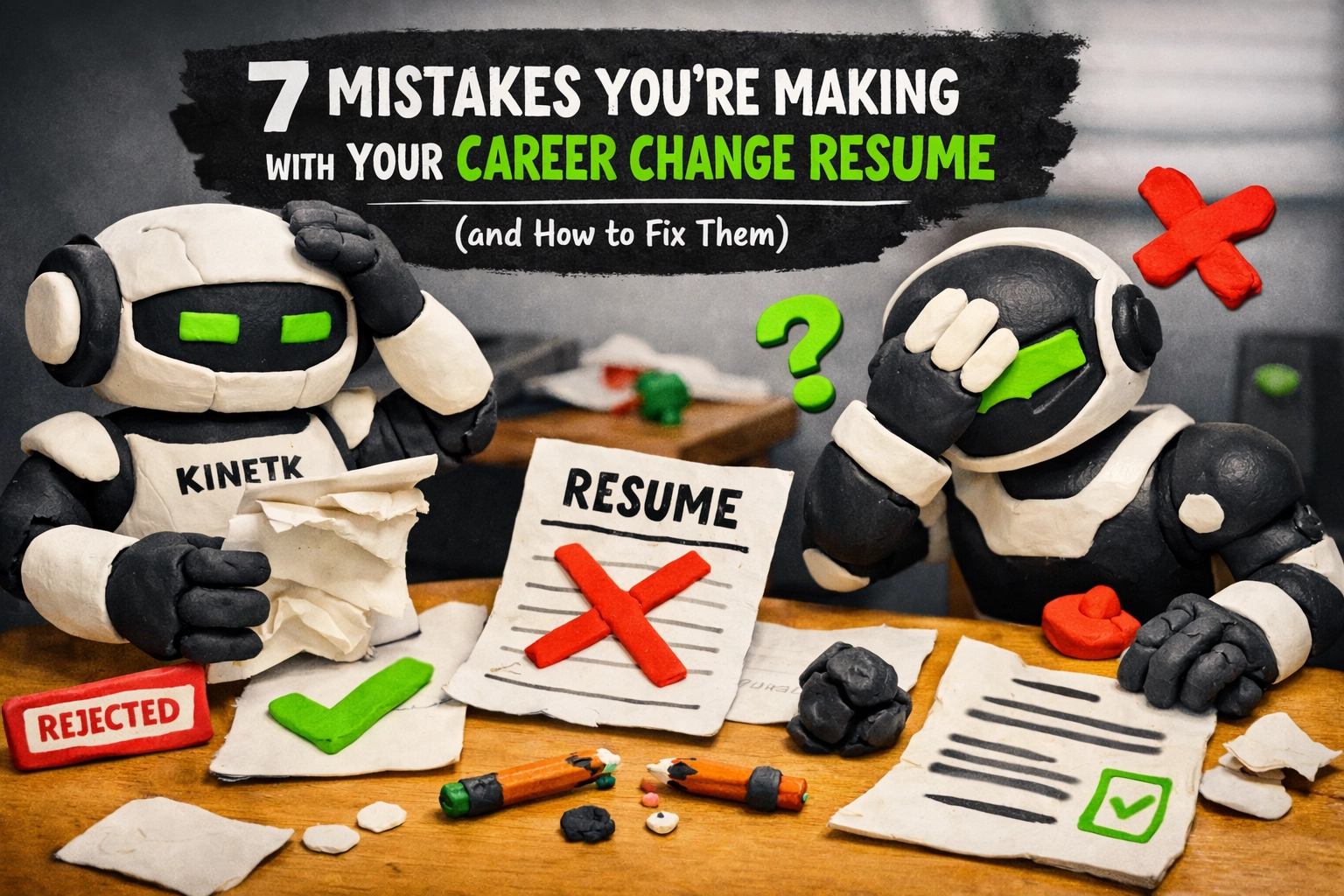
The hard truth: 75% of resumes are rejected by Applicant Tracking Systems (ATS) before a human ever sees them. For career changers, that number climbs even higher. If you are trying to pivot from hospitality to tech, or from finance to creative operations, using your old resume isn't just a "bad idea", it’s a guarantee of failure.
The market has shifted. In 2026, recruiters are dealing with record-high application volumes, and they rely on AI-driven filters to thin the herd. If your resume speaks the language of your past rather than the language of your future, you are invisible. Patience isn't optional; precision is.
Here are the 7 critical mistakes you are making with your career change resume and the exact framework to fix them.
1. Using a "Legacy" Resume Template
The biggest mistake career changers make is "polishing" their old resume. You change a few bullet points, update your contact info, and hit send.The Impact: ATS software parses data based on context. If your resume is built on a 2022 template designed for your old industry, the "weights" assigned to your skills will be skewed toward your previous career. You will be flagged as "unqualified" because your core keyword density is misaligned with the new role.
The Action: Start from scratch. You need a modern, ATS-compliant structure. Our 2025 ATS Resume Guide breaks down the exact formatting requirements that modern parsers demand. Stop trying to fit a square peg in a round hole.
2. Failing to "Translate" Your Skills
You might have been a "Floor Manager," but in the corporate world, you were a "Regional Operations Coordinator." If you keep your old titles and jargon, the ATS won't recognize your value.The Impact: Hiring managers spend an average of 6 seconds scanning a resume. If they see industry-specific jargon that doesn't match their world, they move on. They aren't going to do the mental heavy lifting to figure out how your skills apply to them.
Instead of/Write: * Instead of: "Managed a team of 10 servers in a high-volume environment." * Write: "Directed cross-functional team operations and optimized workflow efficiency to increase revenue by 15%."
The Tool: This is where the VANTAGE-7 engine becomes your unfair advantage. VANTAGE-7 doesn't just swap words; it re-frames your entire professional narrative. It analyzes the target job description and maps your existing experience to the specific linguistic patterns of the new industry.
 Tactile Claymation style image showing a character sitting at a desk, carefully swapping out colorful clay puzzle pieces representing "Old Skills" for "New Industry Keywords."
3. Prioritizing "Passion" Over Proof
"I am a passionate, fast learner looking to transition into digital marketing."The Impact: This sentence is a waste of prime real estate. Recruiters don't hire passion; they hire solutions to problems. In a competitive market, leading with a "soft" objective statement tells the recruiter you don't have the technical goods to back up your application.
The Action: Replace your objective with a Professional Summary that leads with quantifiable data. * Trend: Data-driven hiring. * Action: Mention specific software, certifications, or metrics that prove you’ve already done the work to bridge the gap.
4. Keeping Irrelevant "Ghost" Experience
If you’re moving into Project Management, the fact that you were "Employee of the Month" at a retail job ten years ago is irrelevant. It’s "ghost" content, it takes up space and dilutes your high-impact keywords.The Impact: Lengthy resumes that lack focus are often penalized by modern ATS algorithms. The system looks for "keyword density." By keeping 40% of your resume dedicated to an unrelated past, you are lowering the percentage match for the job you actually want.
The Action: The "Next 30 Days" plan:
5. The "Keyword Stuffing" Trap
You’ve heard that you need keywords, so you list "Project Management, Python, SEO, Leadership, Sales" in a massive block at the bottom.The Impact: Modern AI parsers are smarter than this. They look for contextual evidence. If "Python" is in your skills list but never appears in your "Experience" section with a result attached to it, the ATS assigns a lower confidence score to that skill.
The Action: Every "hard skill" listed must be tied to a bullet point in your work history. If you claim to be an expert in CRM software, your experience section must detail how you used it to drive results.
 Tactile Claymation style image of a resume being scanned by a futuristic lens, highlighting specific keywords that glow with neon energy.
6. Ignoring "Hidden" Industry Jargon
Every industry has its own "secret" language. If you are moving into SaaS (Software as a Service), you need to talk about "Churn," "MRR," and "LTV." If you use generic terms like "Customer Retention," you look like an outsider.The Impact: Even if you pass the ATS, the human recruiter will flag you as "too green" if you don't use their dialect.
The Action: Use the VANTAGE-7 engine to identify these "insider" terms. The engine scans thousands of successful resumes in your target field to ensure your phrasing matches the current industry standard. This isn't about lying; it's about being bilingual in your career.
7. Sending a Generic "AI-Generated" Document
With the rise of ChatGPT, recruiters are being flooded with generic, "perfect" sounding resumes that all look the same.The Impact: Generic resumes fail. They lack the "human" element of specific achievements. If your resume sounds like a robot wrote it, a robot will likely reject it for lacking specific, unique data points.
The Action: You must provide the "meat." AI can help you structure and re-phrase (using a specialized tool like KINETK), but you must provide the specific numbers. Did you save $50k? Did you increase efficiency by 20%? Generic statements don't get interviews. Results do.
The 90-Day Pivot Plan
* Days 1–15: Research your target industry. Identify the top 5 "Power Skills" requested in every job post. * Days 16–30: Use the VANTAGE-7 engine to re-map your old experience to these new skills. * Days 31–60: Run your new draft through the KINETK ATS Checker. Aim for a match score of 85% or higher. * Days 61–90: Start high-volume, targeted applications. Monitor which versions of your resume get the most LinkedIn profile views.
Related Reading
* KINETK vs Jobscan: Why Keyword Matching is No Longer Enough * How to Identify High-Impact Keywords for Your Next Role * 10 Reasons Your Resume Isn't Working (And How to Fix Them)Stop guessing and start landing. If you're serious about your career change, you need a resume that works as hard as you do. Let KINETK build your career-change narrative with the precision of AI and the expertise of recruiters.