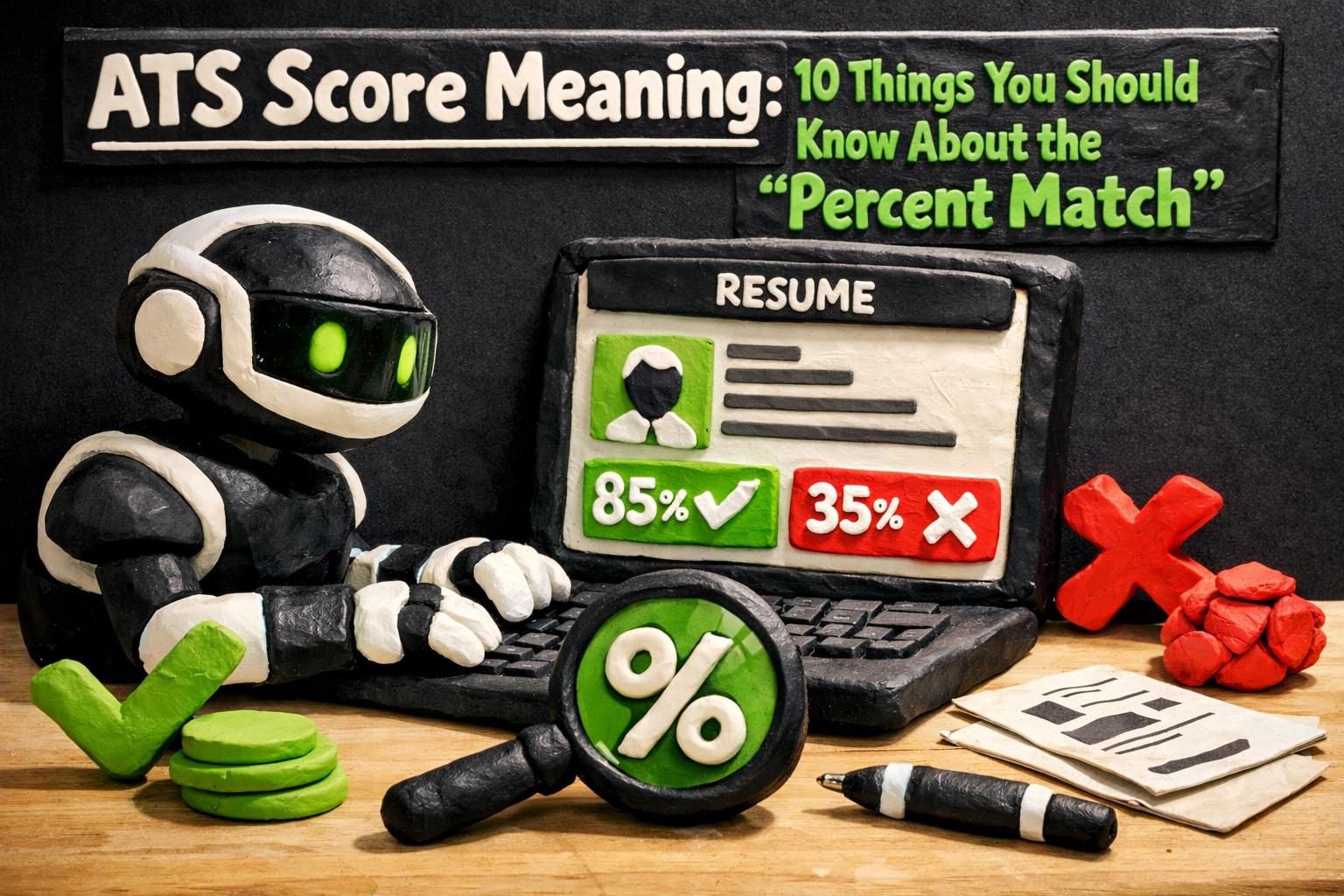
ATS Score Meaning: 10 Things You Should Know About the \"Percent Match\"
Most job seekers are chasing a ghost. You spend hours tweaking bullet points, adjusting margins, and proofreading for the tenth time, only to upload your resume into a digital void. You hear whispers about an "ATS score" or a "percent match," and you assume it’s a grade: like an A+ for a good career.
It isn’t.
An ATS (Applicant Tracking System) score is not a measure of how good you are at your job. It is a sorting mechanism. It is a mathematical calculation of how well your digital footprint aligns with a specific set of strings and variables defined by a recruiter. If you don't understand the math, you don't get the interview. Period.
In 2026, the bar has been raised. Generic resumes fail because the algorithms have become more "skeptical" of fluff. If you want to stop being a statistic in the 75% of resumes that are never seen by a human, you need to understand these 10 hard truths about the ATS percent match.
1. It’s a Sorting Filter, Not a Quality Grade
The most common mistake is thinking a 95% match means you are the best candidate. In reality, that score just means you are the most compliant candidate. ATS platforms like Workday, Taleo, and Greenhouse use these scores to rank a pile of 500 applicants.The recruiter isn't looking at all 500. They are looking at the top 10. If the 10th person has a 88% match and you have an 87%, you are effectively invisible. The score is the gatekeeper. Your "quality" as a human only matters after the algorithm decides you’re worth a glance.
2. The 80% Benchmark is the "Safety Zone"
Data shows that resumes scoring 85% or higher are approximately 3x more likely to result in an interview callback compared to those scoring below 50%. While every company sets its own thresholds, 80% is the universal target for competitive roles.| Score Range | Likely Outcome |
|---|---|
| Below 50% | Auto-rejection or deep archive. |
| 50-64% | High risk of being filtered out immediately. |
| 65-74% | May pass in low-volume pools; risky for tech/finance. |
| 75-84% | Strong chance of passing the initial automated screen. |
| 85%+ | High priority; likely to rank in the recruiter’s top view. |
If you aren't sure where you stand, using an ATS Checker before hitting "submit" is the only way to verify you've hit the safety zone.

3. Keyword Weighting is 40% of the Equation
Keyword matching is the single largest factor in your score. But it’s not just about having the word; it’s about the exact string. If a job description asks for "Customer Relationship Management" and you wrote "CRM," an older ATS might penalize you. Modern systems are better at "knowing" they are the same, but why take the risk?The Impact: A resume covering 90% of required skills will consistently outrank a beautifully written narrative that only covers 50% of the specific jargon the recruiter used.
The Action: Mirror the job description’s exact terminology. If they use "Python," "AWS," and "Agile Methodology," ensure those exact phrases appear in your text. Our 2025 ATS guide breaks down how to balance this without looking like a robot.
4. Semantic Search: The "Context" Revolution
In 2026, the VANTAGE-7 engine has revolutionized how we think about matching. It’s no longer just about "keyword stuffing." Modern ATS platforms now use Natural Language Processing (NLP) to understand context.If you list "Management" as a skill but your bullet points don't describe what you managed (budgets, people, projects), the system might lower your "strength" score for that keyword. The algorithm looks for the "semantic neighborhood" around your skills. It wants to see the tools, the outcomes, and the verbs associated with the high-impact keywords.
 Tactile Claymation style: A small clay figure looking through a magnifying glass at a digital screen where words are glowing and connecting with dotted lines.
5. Why 100% Match is Often a Red Flag
Chasing a perfect 100% match can actually backfire. Recruiters are increasingly wary of "keyword stuffing": the practice of hidden text or just listing every word from the job description in white font.If your resume looks too perfect, a human recruiter will spot it in seconds once they open the file. Your goal is the 85-92% range. This shows high relevancy while maintaining the authenticity of a human-written document. Authentic resumes land jobs; optimized resumes land interviews. You need both.
6. Formatting Errors are "Score Killers"
You could be the perfect candidate with every keyword in the right place, but if your resume uses a multi-column layout or fancy graphics, the ATS parser might fail to read it.When a parser fails, it creates a "parsing error." This often results in a 0% match or a profile that looks like gibberish to the recruiter.
- Instead of: Using tables or text boxes for skills.
- Write: A simple, tabbed, or comma-separated list in standard text.
- Instead of: Putting your contact info in the Header section of Word.
- Write: Place it in the body of the document (some older ATS cannot "see" headers/footers).
7. The Score is Relative to the "Pool"
Your 82% score might be the highest in a pool of 50 applicants, making you the #1 candidate. At a company like Google or Netflix, an 82% might put you at rank #140 out of 2,000.Patience isn't optional; optimization is. You aren't just matching a job description; you are competing against the optimization level of everyone else in that digital pile. If the competition is using AI to optimize, and you aren't, you've already lost.
8. Frequency vs. Recency
Where you put your keywords matters. A skill listed in a "Skills" section counts, but a skill listed in your "Work Experience" from 2024 counts more.The ATS weights keywords based on:
If you haven't used a specific software in five years, don't expect it to carry the same weight as a tool you use daily.
 Tactile Claymation style: A colorful clay bar chart where the tallest bar is labeled "Experience" and the shorter bars represent "Formatting" and "Keywords".
9. The System Doesn't "Feel" for You
The ATS is unsentimental. It doesn't care that you're a "hard worker" or a "quick learner." These are subjective "soft skills" that usually carry a weight of zero in a percent match calculation.Focus 90% of your energy on hard skills, certifications, and quantifiable achievements. "Increased revenue by 20%" is a data point the system can parse. "Passionate about sales" is noise. The bar has raised; stop using fluff and start using figures.
10. How VANTAGE-7 Ensures You're at the Top
The era of manual resume tweaking is over. It’s too slow, and the algorithms are too complex. This is why we built the VANTAGE-7 engine.VANTAGE-7 doesn't just "check" your resume; it reverse-engineers the specific ATS logic used by top-tier firms. It analyzes the job description, identifies the high-weight variables, and helps you restructure your experience to hit that 85%+ sweet spot without sacrificing your professional voice. It’s the difference between guessing and knowing.
 Tactile Claymation style: A sleek, green clay rocket ship (representing VANTAGE-7) blasting off past a sea of grey, flat clay resumes.
Action Plan: Your Next 30 Days
If your current resume isn't working, here is your roadmap:Generic resumes fail. The goal is a resume that works for the machine so it can get to the human. If you're ready to stop the "Apply and Pray" method and start landing interviews, it's time to get serious about your score.
Ready to see your real score? Check your ATS Score now or let our experts handle the heavy lifting by ordering a professional VANTAGE-7 optimization.
*