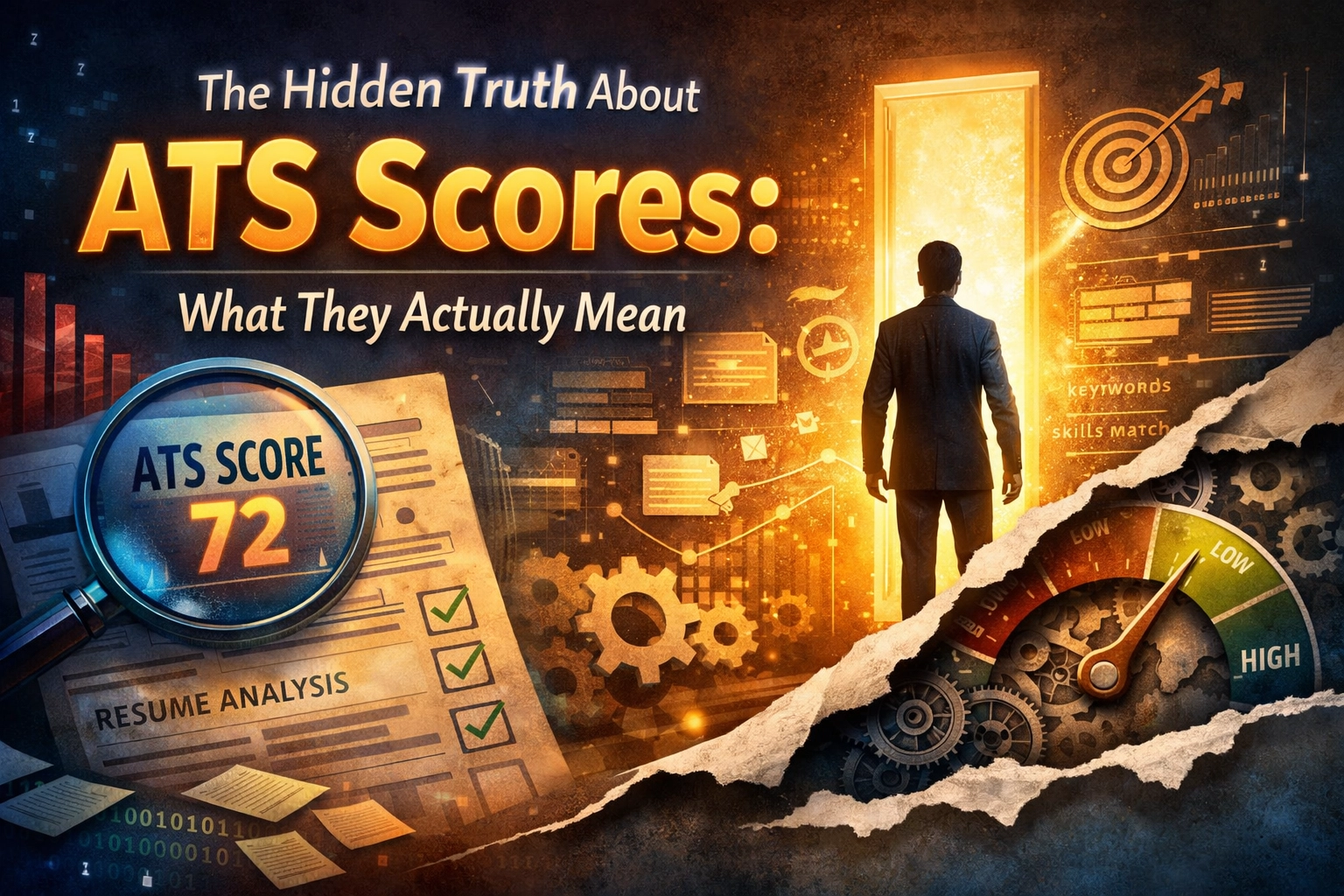
The Hidden Truth About ATS Scores: What They Actually Mean
What does an 89% ATS score actually mean? Uncover the truth about resume scoring and how KINETK ensures you hit the top 5% bracket.
Stop chasing the 100% score. It’s a vanity metric that’s likely keeping you unemployed.
If you’ve spent any time on a modern ats resume checker, you’ve probably felt that hit of dopamine when the little dial turns green and tells you that you’ve hit a 95% match for your dream job. You hit submit, confident that you’re the top candidate, only to receive a generic "thanks, but no thanks" email four hours later.
What gives?
The truth is that your ats score isn't a grade; it's a filter. And more importantly, it’s a relative ranking. In the world of high-volume recruiting in 2026, being "good enough" for the algorithm is just the entry fee. To actually land the interview, you have to understand how these systems prioritize candidates and why a high score can still lead to a rejection.
75% of Resumes Never Reach a Human: The Filter Reality
Let’s look at the cold, hard data. According to recent industry research, 75% of resumes are discarded by the Applicant Tracking System before a recruiter even glances at them.The ATS isn't some "AI overlord" trying to find the best person for the job. It’s a gatekeeper designed to make a recruiter’s life easier by whittling down 500 applicants to a manageable 20.
The Trend: Companies are moving away from simple keyword matching and toward "contextual relevance." The Impact: Just stuffing your resume with keywords won't save you if the ATS can't parse your work history or if your skills aren't weighted correctly against the job description. The Action: You need to stop optimizing for "completeness" and start optimizing for "hierarchy."

What Your ATS Score Actually Measures
When you use a tool like an ats resume checker, it evaluates three primary pillars. If you fail any one of these, your score plummets, and your resume ends up in the "digital abyss."1. Keyword Alignment (30-40% of your score)
This is the big one. The system looks for hard skills (like "Python," "Project Management," or "SEO") and soft skills (like "Leadership" or "Communication"). If the job description mentions "Strategic Planning" five times and your resume doesn't mention it once, you’re already behind. However, simply listing the word isn't enough anymore. Modern systems look for where the word is. Keywords in your "Professional Experience" section carry more weight than keywords buried in a "Skills" list at the bottom.2. Formatting Compatibility
You might think that fancy double-column layout with the infographic sidebar looks "creative." To an ATS, it looks like gibberish. If the system can't read your contact info or your last job title because of a weird table or an unreadable font, your score will be zero. Total. Zero. For a deep dive on how to avoid these formatting traps, check out our ATS Resume 2025 Guide.3. Document Completeness
Does your resume have a phone number? An email? A LinkedIn URL? A clear job title? If the system has to "guess" your location or your seniority level, it will penalize your score.Why a "High Score" Can Still Fail You
Here is the "insider" secret that most resume help services won't tell you: The score is relative, not absolute.Imagine you score an 85% match. That sounds great, right? But if 50 other applicants scored a 90% or higher, you are effectively invisible. Recruiters often sort their dashboard by "Match Percentage." If they only have time to look at the top 10 candidates, and you are number 11, it doesn’t matter if your resume is a masterpiece: it won't be seen.
Furthermore, recruiters have the power to override the system. Research shows that resumes with specific job titles in the headlines receive 3.5x more interviews, regardless of the raw ATS score. Why? Because when a human finally looks at the list, they scan for specific visual markers that an algorithm might miss.
The "Instead of / Write" Framework for Better Ranking
Don't just aim for a high ats score; aim for a high ranking. Use this comparison to adjust your strategy:* Instead of: Listing "Leadership" in a skills cloud. * Write: "Led a cross-functional team of 12 to increase quarterly revenue by 22%." (The ATS sees the keyword, the human sees the impact). * Instead of: Using a "Creative Designer" template from Canva. * Write: A clean, single-column Word or PDF document that follows a standard reverse-chronological format. * Instead of: Applying to 50 jobs with the same resume. * Write: Five highly-tailored resumes using our ATS Checker to ensure you are in the top 5% of the applicant pool for those specific roles.
Different Systems, Different Rules
Not all ATS platforms are created equal. If you are applying to a tech giant, they are likely using Workday or Greenhouse. If you are applying to a high-growth startup, they might be using Lever.* Greenhouse: Prioritizes experience duration and specific "must-have" tags set by the recruiter. * Lever: Is known for being more "human-centric," but still relies heavily on clean parsing of your social links and portfolio. * Workday: Is the "Final Boss" of ATS. It is notoriously picky about formatting. If your resume isn't perfectly structured, it will garble your data, forcing you to manually re-type everything into those annoying little boxes.
Patience isn't optional here. If you don't take the 10 minutes to verify your data during the upload process, you are throwing your application away.

Your 72-Hour ATS Action Plan
Ready to stop being a ghost in the machine? Follow this plan to move from "screened out" to "interviewed."Day 1: The Audit
Take your current resume and run it through a professional ats resume checker. Don't get emotional about the score. Just look at the "Parsed Text" view. If the system thinks your name is "Experience" and your last job was "City, State," your formatting is broken. Fix it.Day 2: The Keyword Strategic Strike
Pick the three jobs you want most. Analyze their descriptions. Are they looking for "full-stack development" or "software engineering"? Use the exact phrase they use. If you need a head start on understanding where the market is headed, read up on Job Market Trends 2025.Day 3: The Human Polish
Once the ATS is happy, make the human happy. Ensure your bullet points start with strong action verbs and end with quantifiable results. An 85%+ score gets approximately 3x more interview callbacks than scores below 50%, but it’s the human-readable content that closes the deal.The Bottom Line
An ats score is a tool, not a trophy. The goal isn't to please the computer; the goal is to use the computer to get to the person who can hire you. Generic resumes fail. Over-engineered resumes fail.The bar has raised. In 2026, you can't afford to guess if your resume is working. You need to know.
If you’re tired of sending resumes into a black hole and want to see exactly how the "gatekeepers" view your profile, it’s time to get serious. We’ve built the tools to help you navigate this. You can check out our full suite of career tools or jump straight to an order to get a professional, ATS-optimized overhaul.
The job market is competitive, but it's not a mystery. Once you know the rules of the game, you can start winning.