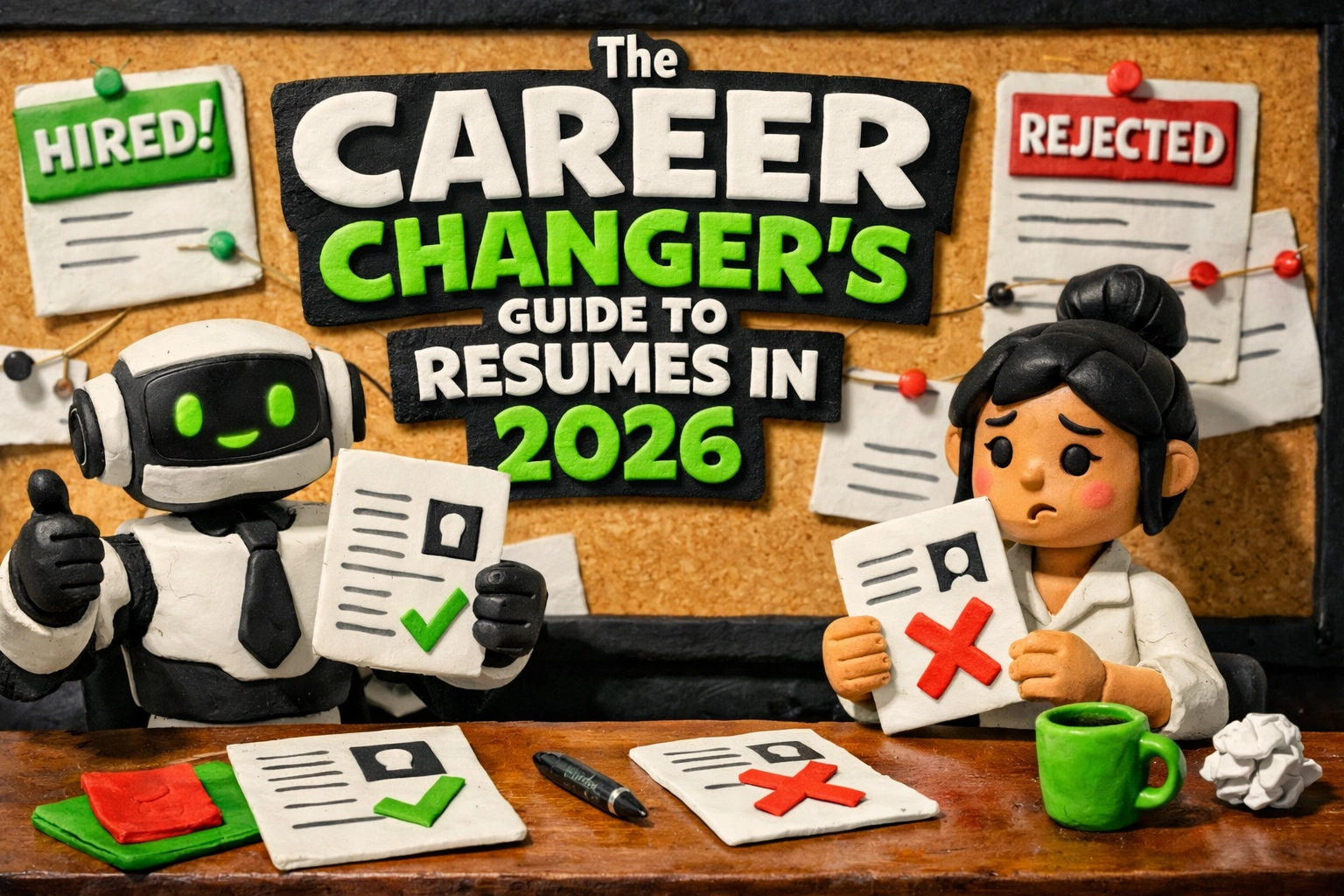
The Career Changer’s Guide to Resumes in 2026
Most career changers are shouting into a digital void, and they don't even know it. If you are currently asking yourself, "why am I not getting interviews," the answer is likely colder than you think: your resume is written for the job you had, not the job you want.
In 2026, the barrier to entry isn't just a human recruiter; it’s a sophisticated AI-driven gatekeeper. Data shows that 75% of resumes are never seen by human eyes because they fail the initial Applicant Tracking System (ATS) scan. For a career changer, this failure rate climbs even higher. When you submit a resume for career change that leads with industry-specific jargon from your old life, you are effectively invisible to the software screening for your new one.
Patience isn't optional here; strategy is. You cannot "follow your passion" into a new role if you can't pass a semantic search.
The 2026 Reality: The "Translation" Gap
Recruiters in 2026 aren't looking for "potential." They are looking for "proof of immediate ROI." When you switch careers, you have a translation problem. You might know that your 10 years in hospitality management make you a killer Project Manager, but an ATS programmed for "Agile," "Scrum," and "SaaS" only sees "Food & Beverage."
The bar has raised. To compete, you need to stop thinking of your resume as a history report and start viewing it as a marketing document. To ensure your foundation is solid before you even begin the rewrite, consult our comprehensive ATS resume guide to understand how these systems parse your data.

1. The Death of the Chronological Resume
The biggest mistake career changers make is sticking to the traditional reverse-chronological format. While this is the gold standard for linear career paths, it highlights your lack of direct experience for a pivot.
The Trend: Moving toward a Hybrid (Combination) Format. The Impact: This allows you to front-load your transferable skills and relevant certifications while still providing the timeline recruiters need to see. The Action: * Create a "Relevant Experience" section: Group your most applicable wins here, regardless of how long ago they happened. * Create an "Additional Experience" section: List your previous roles with fewer bullets, focusing only on high-level achievements. * Focus on the Summary: Your summary must bridge the gap.
Instead of:
"Experienced Retail Manager looking to transition into Digital Marketing."Write:
"Data-driven Marketing Specialist with 8 years of experience in consumer behavior and team leadership. Leveraged CRM tools to increase customer retention by 22% in the retail sector. Certified in Google Ads and HubSpot Content Marketing."2. Solving "Why Am I Not Getting Interviews?"
If you’re applying to dozens of roles and hearing nothing, you aren't hitting the keyword density required for 2026 standards. Modern ATS platforms use semantic search, meaning they look for clusters of related terms. If you want a role in "Cybersecurity" but your resume is filled with "Police Officer" terminology, the algorithm marks you as a 0% match.
The Action Plan:
Generic resumes fail. Every single application for a resume for career change must be tailored. If you don't have the time to do this manually, you're already behind the candidates using AI-optimization tools like KINETK.
3. The Power of Transferable Skills (With Proof)
Transferable skills like "leadership" and "communication" are useless unless they are backed by numbers. In 2026, recruiters ignore soft skills that lack metrics.
Before vs. After: The Career Changer Edition
| Instead of Writing (Old Career) | Write This (New Career Focus) |
|---|---|
| Managed a team of 15 servers at a high-volume restaurant. | **Operations & Leadership:** Directed a cross-functional team of 15 to maintain 98% service efficiency during peak hours. |
| Taught high school English for 5 years. | **Communications & Training:** Developed and delivered complex curriculum to 150+ stakeholders annually, improving performance metrics by 15%. |
| Handled customer complaints in a call center. | **Conflict Resolution & Retention:** Mitigated high-stress client escalations, maintaining a 94% Customer Satisfaction (CSAT) score. |

4. Addressing the "Ghosting" and the "Gap"
Career changers often have gaps: either from taking time off to reskill or because their previous industry is so unrelated it feels like a gap.
What This Means for You: You must fill the gap with active learning. * Certifications: If you are moving into Tech, a CompTIA A+ or a Cloud Practitioner cert isn't just a "nice to have"; it's your entry ticket. * Project Work: If you don't have a job in the new field, create one. Build a GitHub repository, start a professional blog, or take on pro-bono consulting for a non-profit. * The LinkedIn Factor: Your LinkedIn profile must match your new resume. Recruiters will cross-reference. If your resume says "Project Manager" but your LinkedIn says "Former Teacher," you’ve lost their trust.
5. Your 30-Day Pivot Plan
If you want to stop the "thank you for your interest" automated rejections, follow this timeline:
Day 1-7: The Research Phase Identify your "Target Job Titles." You cannot pivot to "anything." Pick three specific roles. Research the industry-specific keywords for 2026.
Day 8-14: The Document Overhaul Rewrite your resume into a hybrid format. Use the KINETK ATS Checker to see how a real system reads your new draft. If your "match score" is below 80%, keep editing.
Day 15-21: The Skill Proofing Add a "Projects" or "Professional Development" section. List the courses you’ve completed this month. Show that you are currently immersed in the new industry.
Day 22-30: Targeted Outreach Stop applying to "Easy Apply" roles on LinkedIn. Find the hiring manager. Send a message that highlights one specific transferable win.
The Bottom Line
A resume for career change is not a list of what you've done; it's an argument for what you can do. If you are struggling with why am I not getting interviews, it is time to stop blaming the market and start auditing your assets.
The AI doesn't care about your journey; it cares about your metadata. Give it the data it wants, and the humans will follow.
Ready to see if your career change resume actually passes the test? Get your professional rewrite here and stop guessing.
Related Reading
* ATS Resume 2025 Guide: Format, Keywords, and Score Fixes * 10 Reasons Your Resume Isn't Working * Vantage 7 Explained: The Future of Recruiting AIReady to see if your career change resume actually passes the test? Get your professional rewrite here and stop guessing.
#CareerChange #ResumeTips2026 #JobSearchStrategy #KINETK #CareerPivot #ATSResume #InterviewTips