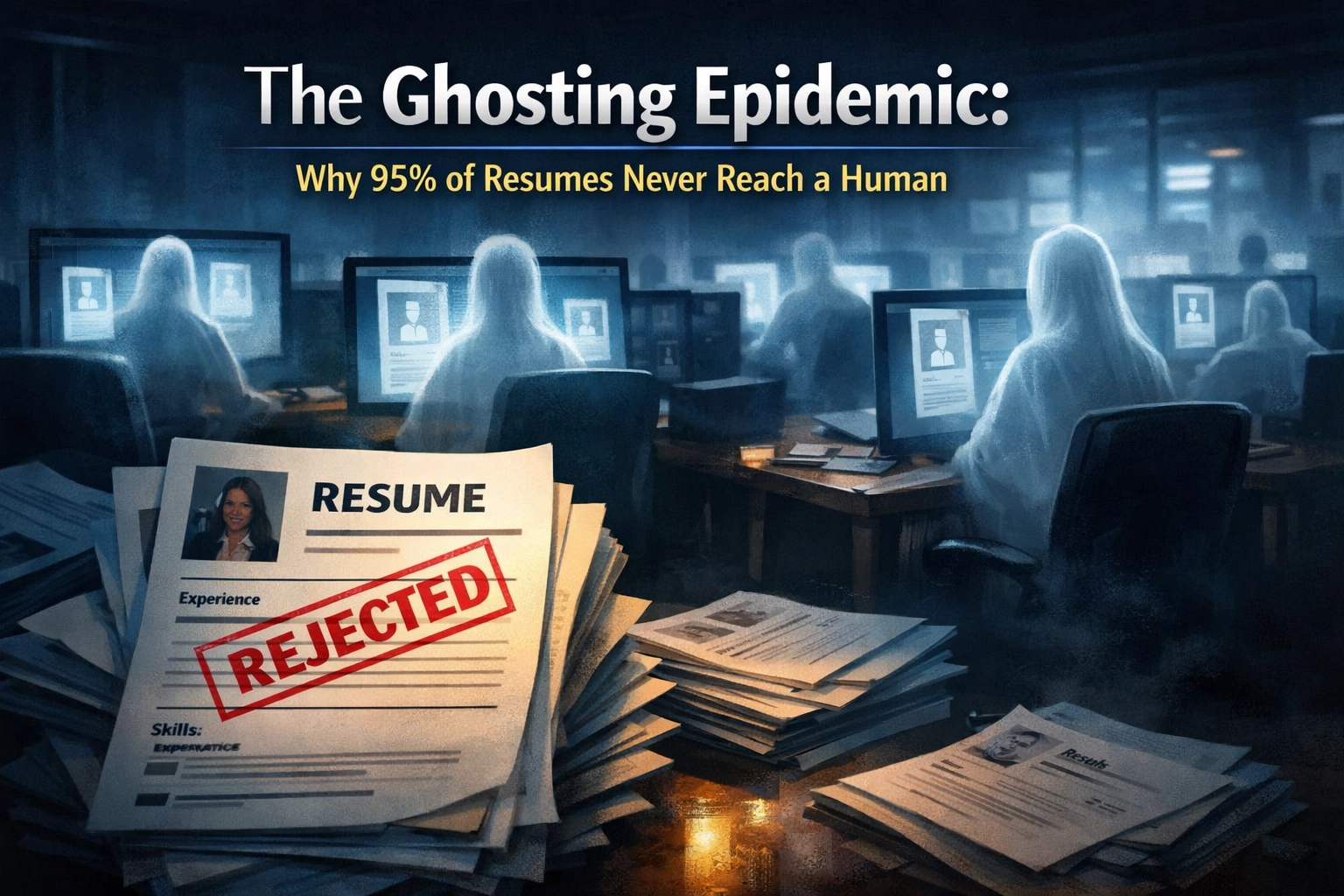
The Ghosting Epidemic: Why 95% of Resumes Never Reach a Human
Why do 95% of resumes fail to reach a human? Discover the 'Ghosting Epidemic' and how to optimize your resume for ATS to land more interviews.
You hit "Submit," the screen flashes a generic thank-you message, and then… nothing. For weeks. You check your email obsessively, wondering why am I not getting callbacks? You’ve got the experience, the degree, and the drive, yet it feels like your application fell into a digital abyss.
The hard truth is that it probably did.
In the modern job market, your resume isn't being read by a human, at least not initially. It’s being processed, parsed, and scored by an applicant tracking system resume scanner. If you aren’t hitting specific, invisible benchmarks, your resume is effectively dead on arrival. While some industry veterans argue over whether the "rejection rate" is 75% or 95%, the reality for the job seeker remains the same: the vast majority of applications are never seen by a recruiter.
The bar has raised. Generic resumes fail. If you want to survive the "ghosting epidemic," you need to stop treating your resume like a biography and start treating it like a search-optimized landing page.
The Industry Shift: Why the Black Hole is Getting Deeper
The recruiting landscape has changed fundamentally in the last 24 months. With the rise of AI-generated applications, recruiters are being flooded with thousands of resumes for a single opening. To cope, companies have dialed up the "strictness" of their ATS filters.
The Trend: Automated gatekeeping is no longer just about keywords; it’s about hard exclusion. The Impact: Even highly qualified candidates are being filtered out before a human even knows they applied because of minor formatting errors or missing "must-have" certifications. The Action: You must optimize for the machine first and the human second.
Patience isn't optional; strategy is. If you’re looking for resume help, you need to understand that the "ghosting" you're experiencing isn't personal, it's technical.

1. The Formatting Trap: Why "Pretty" Resumes Die
We see it every day: a candidate spends five hours on Canva crafting a beautiful, multi-column resume with progress bars for skills and a professional headshot. They submit it, feeling confident.
The result? Immediate disqualification.
Standard ATS software, the kind used by 99% of Fortune 500 companies, struggles to parse complex layouts. When the system encounters columns, tables, or graphics, it often "scrambles" the text. Your 10 years of experience as a Project Manager might be read by the system as a jumble of incoherent dates and locations.
Instead of / Write:
* Instead of: Two-column layouts with sidebars. * Write: A single-column, top-to-bottom layout. * Instead of: Using "Skill Bars" (e.g., 80% proficient in Python). * Write: A "Skills" section with clear, text-based keywords like "Python, Django, AWS." * Instead of: Putting your contact info in the Header or Footer. * Write: Place your contact info in the main body of the document. Many older systems ignore headers/footers entirely.If the system can't read your data, it can't score you. If it can't score you, you stay in the "ghost" pile. You can check how a system sees your current document by using an ATS checker.
2. The Keyword Gap: The Currency of Hiring
If you’re wondering why am I not getting callbacks, the answer usually lies in your keyword density. Recruiters don’t browse resumes; they search for them. They type "Salesforce," "B2B SaaS," and "Quota Attainment" into a search bar. If those exact strings aren't on your resume, you don't exist in their results.
What This Means for You: Your resume must be a mirror of the job description. If the job post asks for "Customer Success Management" and you wrote "Client Relationship Lead," you might miss the filter. The ATS isn't always smart enough to realize those are the same thing.
The 30-60-90 Day Optimization Framework
To break the ghosting cycle, you need a systematic approach to your applicant tracking system resume strategy.
#### Next 30 Days: The Foundation * Audit your file type: Switch from "Pretty PDF" to "Standard PDF" or .docx. Scanned images of resumes are invisible to ATS. * Kill the "Objective": Replace it with a "Professional Summary" loaded with high-value keywords relevant to your target role. * Standardize Job Titles: If your internal company title was "Happiness Hero" but you were a Customer Support Lead, use "Customer Support Lead" on your resume.
#### Next 60 Days: The Alignment * Tailor every application: Use tools to identify the top 10 keywords in every job description you apply for. * Quantify everything: Don't just say you "managed a team." Say you "Managed a team of 12 across 3 time zones, increasing output by 22% in Q3." Numbers are universal; they bypass language nuances in parsing. * Check for "Hard Filters": Many companies have auto-rejection set for candidates who don't check a specific box (e.g., "Do you have a PMP certification?"). If you don't, and it's a hard filter, no amount of resume tweaking will help.
#### Next 90 Days: The Expansion * Optimize LinkedIn: Ensure your LinkedIn profile matches the "optimized" version of your resume. Recruiters often jump from the ATS to your profile to verify your "social proof." Check out our LinkedIn optimization tips for a deep dive here. * Network to Bypass the Bot: The only way to 100% avoid the ATS is a direct referral. Use your optimized resume as a talking point, not just a cold submission.

3. The "Ghost Job" Phenomenon
Sometimes, it’s not you, it’s the market. In 2025 and 2026, we’ve seen a rise in "ghost jobs", postings that companies keep active even when they aren't actively hiring. This builds a "talent pipeline" for later.
The Impact: You apply to a job that was never going to be filled this month. The Action: Focus your energy on jobs posted within the last 48–72 hours. These are the "active" fires companies are trying to put out. Applications submitted after the first week of a posting have a 60% lower chance of being viewed.
4. The KINETK Advantage: Why VANTAGE-7 is Different
At KINETK, we realized that the "Standard" resume help wasn't working anymore. Giving someone a better-looking template doesn't solve the parsing problem. That’s why we developed VANTAGE-7.
Instead of just checking for keywords, we analyze the architectural integrity of your resume against the specific algorithms used by Workday, Greenhouse, and Lever. We don't just hope a human sees your resume; we ensure the system forces them to.
The "Ghosting Epidemic" is a symptom of a broken, automated system. You can complain about the system, or you can learn to speak its language.
Final Checklist: Before You Hit "Submit" Again
Stop sending your career into the void. The gap between "Applied" and "Interviewing" is smaller than you think: it’s just guarded by a machine that demands perfection.
Ready to stop being a ghost? Get your resume optimized by KINETK today and see what happens when your resume actually reaches a human.