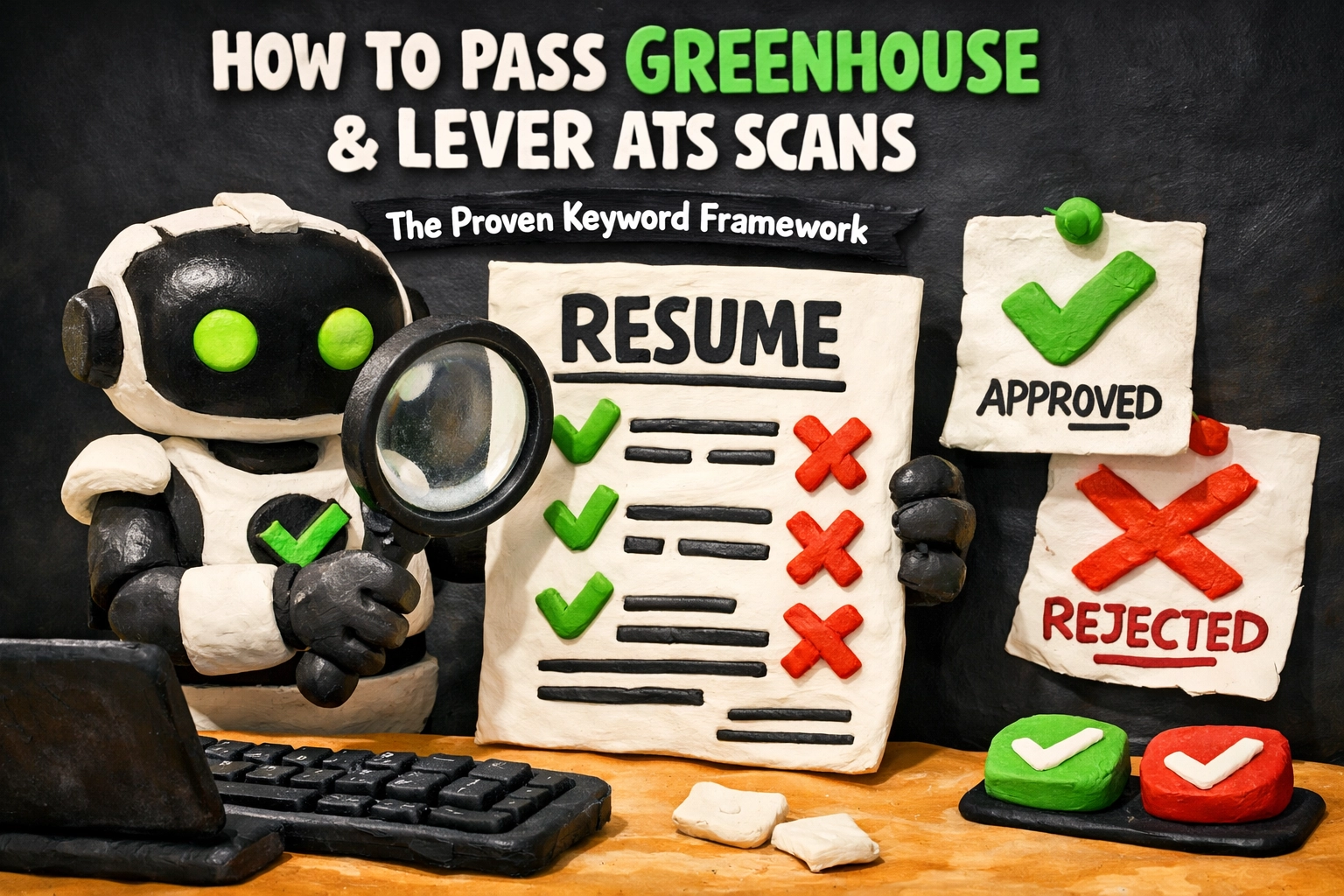
How to Pass Greenhouse and Lever ATS Scans: The Proven Keyword Framework
Stop treating your resume like a creative writing project. If you are applying to high-growth tech companies or modern startups, your document is being processed by Greenhouse or Lever. These aren’t the "black hole" systems of 2010. They are sophisticated data-parsing engines designed to filter out the noise. Currently, 75% of resumes are rejected before a human ever sees them. The reason isn't always a lack of talent; it is a lack of technical alignment.
The reality is harsh: The bar has raised. Traditional keyword stuffing: the practice of hiding white text at the bottom of a page: is dead. Modern Applicant Tracking Systems (ATS) now utilize semantic search and "Weighted Keyword Proximity." If your resume doesn't mirror the specific architectural DNA of the job description, you are invisible. This is the truth about how Greenhouse and Lever actually work, and the framework you need to survive the scan.
The Modern ATS Landscape: Greenhouse vs. Lever
To beat the system, you must understand the engine. While legacy systems like Taleo are often blamed for "ghosting" candidates, Greenhouse and Lever are built for speed and collaborative hiring.
The Greenhouse "Scorecard" System
Greenhouse doesn’t just scan for keywords; it facilitates a Scorecard. When a recruiter opens your profile, the system highlights how well you match the "Must-Haves" defined by the hiring manager. If the system fails to extract your "Python" or "Project Management" experience because of poor formatting, your score drops. You aren't just losing to other candidates; you are losing to a data-parsing error.The Lever "Unified Pipeline"
Lever operates on a "Candidate-Centric" model. It creates a single profile for you that follows you across multiple applications. If you submit a generic resume for one role and a specialized one for another, the system flags the inconsistency. Generic resumes fail because they lack the high-signal density required to move from the "New Lead" stage to "In Review."
The Trend: From Keyword Stuffing to Semantic Alignment
The Trend: Hiring teams are moving away from simple "CTRL+F" keyword searches. They are using AI-driven tools that understand the relationship between words.
What This Means for You: It is no longer enough to list "Sales" as a skill. You must provide the context. The ATS is looking for "Enterprise SaaS Sales," "Lead Generation," and "Quota Attainment."
The Action: You must transition from a "List-Based" resume to a "Context-Based" framework.
The Proven Keyword Framework: The 3-Tier Strategy
To pass a Greenhouse or Lever scan, your keywords must be organized into three distinct tiers. This ensures that the parser identifies your core competencies immediately while the human recruiter sees the impact.
#### Tier 1: Hard Skill Extraction (The "What") These are the non-negotiables. If the job description mentions "AWS," "SQL," or "Agile Methodology," these words must appear in your Skills Section and within your Professional Experience. * Instead of: Experienced in cloud computing. * Write: Architected scalable infrastructures using AWS (EC2, S3, Lambda) to reduce latency by 20%.
#### Tier 2: Domain Expertise (The "How") These keywords define your seniority and niche. Greenhouse "Scorecards" often prioritize these. * Examples: Strategic Planning, Cross-functional Leadership, P&L Management, Full-stack Development.
#### Tier 3: Tool-Specific Keywords (The "Where") Modern companies want to know you can hit the ground running with their tech stack. If you use Jira, Salesforce, Greenhouse, or Figma, list them explicitly.
Formatting for the Parser: Avoiding the 40% "Data Loss"
Many candidates lose the "ATS game" before the first word is even read. Complex layouts, columns, and graphics often cause parsing errors. When a resume is parsed by Lever, the system attempts to turn your beautiful PDF into a structured digital profile. If it can't read your "Work History" because it's stuck in a sidebar, your application is effectively blank.
The Golden Rules of ATS Formatting
Before vs. After: The Keyword Transformation
Let's look at how to transform a "Generic" bullet point into an "ATS-Optimized" powerhouse.
The Generic Approach (Likely to be filtered): > "Managed a team of developers to build a new app and improved performance."
The KINETK Framework Approach (High-Signal): > "Led a cross-functional team of 12 Software Engineers using Agile/Scrum to launch a React-based mobile application, resulting in a 15% increase in user retention and a 30% reduction in server-side latency."
Why this works: * It hits Job Titles (Software Engineers). * It hits Methodologies (Agile/Scrum). * It hits Tech Stacks (React). * It hits KPIs (User retention, Latency).
Next 30 Days: Your ATS Action Plan
If you are currently struggling to get callbacks, follow this immediate implementation plan:
* Days 1-5: Audit your current resume. Use the KINETK ATS Checker to identify "parsing dead zones." * Days 6-15: Rebuild your "Professional Experience" section. Ensure every bullet point contains at least one Tier 1 or Tier 2 keyword found in the job descriptions you are targeting. If you're targeting Project Manager roles, review our Project Manager Resume Examples for inspiration. * Days 16-25: Optimize your LinkedIn profile. Lever often "scrapes" LinkedIn to update your candidate profile. Consistency is key. * Days 26-30: Begin applying with your "High-Signal" resume. Track your response rate. If you are still seeing high rejection rates, you may be falling victim to the Ghosting Epidemic.

Why You’re Not Getting Callbacks
If you’ve optimized your keywords and you’re still not getting interviews, the problem might be your Keyword Density. Over-optimizing (stuffing) can trigger "Spam" filters in modern ATS platforms. Greenhouse, in particular, tracks "Relevance Scores." If your resume contains 50 keywords but lacks the narrative structure to support them, the system flags it as low-quality.
For a deeper dive into why your applications might be stalling, read our guide on Why Your Resume is Not Getting Callbacks.
The KINETK Advantage
The game has changed. You can no longer rely on "hoping" a recruiter sees your potential. You have to force the system to acknowledge your expertise. At KINETK, we built VANTAGE-7, an AI engine specifically designed to simulate the parsing logic of Greenhouse, Lever, and Workday.
We don't just give you a "score." We give you the exact keyword framework required to move your application from the "Archived" pile to the "Hired" list. Understanding the machine is the first step; mastering it is the second.
Stop guessing. Start landing.
Ready to see what the ATS really thinks of you? Optimize Your Resume Now
#ATSKeywords #GreenhouseATS #LeverATS #ResumeOptimization #JobSearch2026 #CareerHacks #KINETK #RecruitingAI #JobApplicationTips #ResumeParsing #LandHired